Heat Pumps
Heat Pumps Explained
What's on this page:
- What Are They?
- What Extracts The Heat From The Ground - Water - Air?
- How Does The Heat Exchange Process Work?
- More information
What Are They?
A heat pump is a machine that can take heat from one place and then deliver that heat to another place at a higher temperature.
This heat can be extracted from:
- Ground
- Water
- Air
Your home refrigerator operates using the same principle - it just draws the heat from the contents of your refrigerator and dispatches that heat through the heat exchanger (the grill) at the rear of the refrigerator.
The efficiency of all heat-pumps (ground, water and air) far exceeds that of traditional heating systems. For example, for every dollar you spend on heating using HP's you get the equivalent of 3 dollars or more of heating back.
The home refrigerator again is a good example of the efficiency of these systems in transferring heat (keeping the contents cold) at very low running costs (and don't forget, your refrigerator is on 24 - 7).
What Extracts The Heat From The Ground - Water - Air?
The key ingredient for extracting the thermal energy heat from the ground, water, or air, as with your refrigerator, is the 'refrigerant' in the heat exchange captors (the coils).
Because chlorofluorocarbons (CFCs), along with other chlorine and bromine containing compounds, have been implicated in the accelerated depletion of ozone in our Earth's stratosphere (which isn't good) new refrigerants have been introduced such as R407C, R134a and R410A.
For refrigeration applications, R404A is preferred because it has a better low temperature efficiency and lower discharge temperatures, but in ground source heat pumps and air conditioning, R407C has a better efficiency characteristic.
This refrigerant will vaporise into gas at a boiling point far lower than 100oC that water takes to boil (at sea level).
How Does The Heat Exchange Process Work?
Cold liquid refrigerant passes through a heat exchanger (evaporator) absorbs the heat from its surroundings and evaporates into gas. The gas is then compressed raising it to a higher temperature.
This hot gas then passes through a second heat exchanger (condenser) and gives up its heat to the surrounding atmosphere (a water or air heating circuit) before it is condensed into liquid.
The condensed refrigerant liquid still at high pressure and still hot, is then forced through an expansion valve which causes it to rapidly cool through evaporation. The now cool refrigerant liquid is ready to absorb more heat from the evaporator causing the liquid refrigerant to evaporate into gas.
Refrigerants typically evaporate at around -2oC so are able to collect heat in the winter. This process is controlled by an evaporator, a compressor, a condenser and an expansion valve.
(see graphic below).
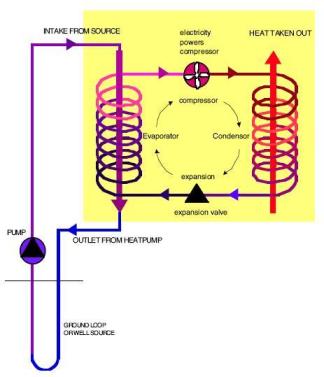 Heat exchange process
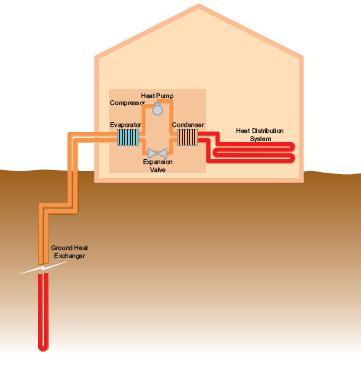 Heat transfered to house
More on the different types of heat-pumps below:
- Thermal Energy Heatings - Ground source
- Hydronic Heating Cooling - Water Source
- Air Source Heat Pumps - Air source
Click here to visit online store.
Home Heat Loss Heat Gain Radiant Heat Central Heating Radiators UFH
Heat Pumps GSHP's WSHP's ASHP's Solar Heating PV Systems Boilers
Water Heaters Insulation Elec-Heaters
Terms of Use | Privacy | Contact Us



|

Visitors Say
Hi, My name is Shannon and I'm one of home-heating-systems-and-solutions.com readers. I'd like to thank you for the excellent information I've found on home-heating-systems-and-solutions.com, it's one of my favorite readings on the net. Warmest Regards Shannon United States
Thanks for the advice for removing an air lock from an indirect system. Had to change an inlet on my cistern. First time I have tried any home plumbing. After draining the cold tank system air locked when I refilled the tank. Garden hose and mains pressure up the tap sorted my problems. Would not have known what to do without the advice on the site. Many thanks Sean United Kingdom.
An excellent site. I have found it very usefull. I am currently in the design phase of a new house and have be pondering which heat system to use. From your site I have been able to choose the right system. Ross New Zealand
I enjoyed your site. Pat United States
We're so excited to announce our first Children Book
The Special and Talented Dog Show
To order click here
The second book published is called
Flying Things
This is aimed at a pre-school audience and is a rhyming story. You can buy by clicking here
To read more about our children's books, click here
