Domestic Hot Water Radiators
What Are Hot Water Radiators?
Designer marble radiator Domestic/residential hot water radiators, or simply central heating radiators, are really just 'heat emitters' that are used for space heating and although commonly called radiators, only 20% of the heat given off by a radiator is actually radiant heat - contrary to popular belief, in fact 80% is given off through convection.
This is simply because the radiator exposes a hot surface in a room that creates convection currents and so circulates the warmed heated air above by attracting colder air at the bottom.
Most central heating radiators are water-based. You can however buy stand-alone oil-filled electric radiators but this page refers only to water-based radiators.
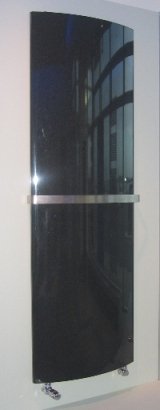 Designer Radiator
 |
How Do Radiators Work?
Quite simply really. Radiators are really just vessels that allow, in this case, hot water to circulate through it. Because water has a specific heat value a hot water radiator can be sized through calculation to correctly replace the room's heat loss and maintain your required thermal comfort.
Heat to an individual hot water radiator can be controlled manually through the wheel head valve, or automatically by a thermostatic radiator valve (TRV) which stops the hot water flow when the room has reached the pre-set temperature.
Central heating radiators, as opposed to underfloor heating, have a fast response time in both heating up and cooling down.
How Many Types Of Radiators Are There?
There are several designs of hot water radiators ranging from;
- Column Radiators
- Panel Radiators - single or double
- Convector Radiators - single or double
- Convector Heaters - skirting/baseboards
- Fan Assisted convectors
- Low Surface Temperature Radiators
- Designer Hot Water Radiators - with or without convectors
- More information
Column radiators are generally made from cast iron and are floor standing as opposed to wall mounted steel or aluminium/aluminum panel radiators. These types of radiators are mainly used in public buildings such as older hospitals and schools.
They can be used in homes and are becoming fashionable; however they are quite large and have a high water content which will mean an overall increase in the system's water content for central heating, and that means you will spend more to heat up all that water.
Panel radiators are generally made from mild steel but more frequently they being made from alumium/aluminum as this material is far better at emitting heat than steel. Panel hot water radiators come as single or double panel. Double panel reduces the size of the radiator but increases it heat output.
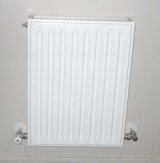 Single Panel Radiator
Some of the new types of radiators are low water content radiators. Inside the radiator's casing is a heat exchanger - a pipe covered with a heat conduction fins.
Low water content heat exchanger radiators in a sealed heating circuit with a modern high efficient modulating system or condensing boiler will reduce your running cost compared to a non high efficient boiler with panel or column radiators in an open-vented system.
Convector radiators are different to panel radiators only by the fact that they have conductor fins or panels at the back of the radiator. These are designed to increase the surface area of the radiator and through conduction, heat these fins/panels so that more air that passes behind the radiator is heated.
Convector heaters consist basically of a heating pipe that is covered with fins to amplify the heat through conduction on the increased surface area They usually come in the form of skirting/baseboard convector heaters and in floors beneath floor grills.
Fan assisted convectors are generally larger and wall mounted with variable speed fan control. This type of convector offers quicker response but with an added cost, the electrical energy for the fan.
Low surface temperature radiators are low water content radiators with a protective external casing designed to prevent the young and old from burning themselves. The actual radiator is a fin covered heat exchanger inside the casing that releases it's heat as normal to the room via grills at the top of the casing while allowing cooler air to enter the casing through grills at the bottom.
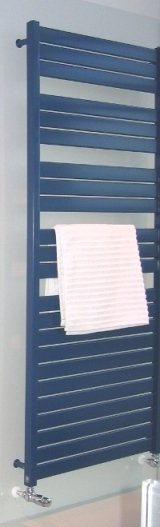 Towel Radiator
Designer hot water radiators are generally made from steel and can be made into any kind of feasible shape from cloak and hat stands, to benches, bathroom vanities, ornamental stone radiators, stylized towel rails.
The list goes on; you are limited only by your imagination. Designer radiators are a lot more expensive than traditional residential radiators. But then they are not just radiators...
Designer central heating radiators are fast becoming fashionable as artwork and as functional units as well as being heat emitters for your home.
Useful Links
- Warming people's homes with hydronic heating in NZ
|
Got any good plumbing tips? |
Click here to visit online store.
Home Heat Loss Heat Gain Radiant Heat Central Heating Radiators UFH
Heat Pumps GSHP's WSHP's ASHP's Solar Heating PV Systems Boilers
Water Heaters Insulation Elec-Heaters
Terms of Use | Privacy | Contact Us



|

Visitors Say
Hi, My name is Shannon and I'm one of home-heating-systems-and-solutions.com readers. I'd like to thank you for the excellent information I've found on home-heating-systems-and-solutions.com, it's one of my favorite readings on the net. Warmest Regards Shannon United States
Thanks for the advice for removing an air lock from an indirect system. Had to change an inlet on my cistern. First time I have tried any home plumbing. After draining the cold tank system air locked when I refilled the tank. Garden hose and mains pressure up the tap sorted my problems. Would not have known what to do without the advice on the site. Many thanks Sean United Kingdom.
An excellent site. I have found it very usefull. I am currently in the design phase of a new house and have be pondering which heat system to use. From your site I have been able to choose the right system. Ross New Zealand
I enjoyed your site. Pat United States
We're so excited to announce our first Children Book
The Special and Talented Dog Show
To order click here
The second book published is called
Flying Things
This is aimed at a pre-school audience and is a rhyming story. You can buy by clicking here
To read more about our children's books, click here
