Open Vented Cylinders
Open vented cylinders are low pressure hot water storage cylinders,i.e, water is supplied to these cylinders from a cold water storage cistern/tank (usually located in the loft/roof space) and not directly from the water mains like the mains pressured unvented cylinders.
In many older properties you may still find open vented cylinders, however, they can be easily replaced with the more efficient unvented cylinder which will supply high pressure hot water with a much improved water flow rate.
The efficiency of an open vented cylinder to deliver water to the taps/faucets is directly dependent on the pressure (static head) that is applied by the water held in the cold water storage cistern/tank.
Note: The minimum required storage capacity for a cold water storage cistern/tank that provides water to both hot and cold taps/faucets is 227 litres.
The minimum distance between the top of the hot water cylinder and the bottom of the cold water cistern/tank should be 1 meter. However, the higher the cold water cistern/tank is above the hot water cylinder and the water outlet points (taps/faucets), the greater the water pressure will be.
Note: The pipe size is an important aspect with vented cylinders to ensure sufficient water flow especially if the cold water storage cistern/tank is installed around the 1 meter minimum separation above the hot water cylinder, or when a number of outlets are being served at the same time.
It is also important to maintain the water level in the cold water storage cistern/tank during multiple draw offs. You can increase the diameter of the connecting rising main pipe and also fit a 'larger bore' isolating stop-valve supplying the cold water storage cistern/tank to maintain the water level.
An open vented cylinder can be directly or indirectly heated:
- Directly heated by a 3KW (kilowatt) electric immersion heater
- Indirectly heated by a boiler that also provides central heating
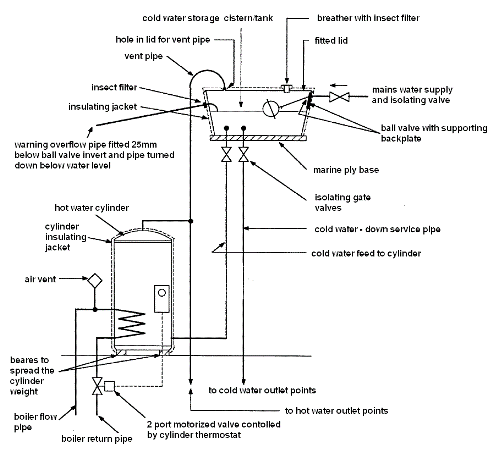 The above picture shows the layout for an indirectly heated open vented cylinder
Secondary Circulation
If the hot water supply pipes have to run long distances to reach the outlet points (taps/faucets) you will experience what's called 'dead-legs'.
A dead-leg is simply the amount of cold water that has to be run off a section of the hot water service pipe from the hot tap/faucet before getting hot. The longer the pipe section is the longer the hot water will take to get there.
You can overcome this by having a 'secondary circulation' fitted to the hot water cylinder. This is when the the hot water sevice pipe from the hot water cylinder doesn't terminate at the taps/faucets but loops back to the hot water cylinder. Circulation is achieved by installing a bronze pump circulator (quite expensive) on the secondary return enabling instant hot water availability at taps/faucets.
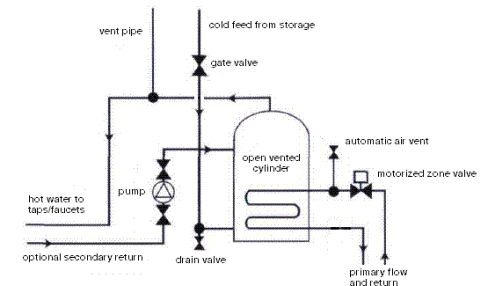 The above picture shows a secondary circulation layout
Top of Open Vented Cylinders page
Click here to visit online store.
Home Heat Loss Heat Gain Radiant Heat Central Heating Radiators UFH
Heat Pumps GSHP's WSHP's ASHP's Solar Heating PV Systems Boilers
Water Heaters Insulation Elec-Heaters
Terms of Use | Privacy | Contact Us



|

Visitors Say
Hi, My name is Shannon and I'm one of home-heating-systems-and-solutions.com readers. I'd like to thank you for the excellent information I've found on home-heating-systems-and-solutions.com, it's one of my favorite readings on the net. Warmest Regards Shannon United States
Thanks for the advice for removing an air lock from an indirect system. Had to change an inlet on my cistern. First time I have tried any home plumbing. After draining the cold tank system air locked when I refilled the tank. Garden hose and mains pressure up the tap sorted my problems. Would not have known what to do without the advice on the site. Many thanks Sean United Kingdom.
An excellent site. I have found it very usefull. I am currently in the design phase of a new house and have be pondering which heat system to use. From your site I have been able to choose the right system. Ross New Zealand
I enjoyed your site. Pat United States
We're so excited to announce our first Children Book
The Special and Talented Dog Show
To order click here
The second book published is called
Flying Things
This is aimed at a pre-school audience and is a rhyming story. You can buy by clicking here
To read more about our children's books, click here
