Two Pipe System - Hydronic Central Heating
The two pipe system is the most commonly used configuration in the installation of hydronic central heating systems. These systems are 'fully pumped', meaning that the circulation of water in the central heating circuit is pumped.
Note: Underfloor heating can also be a 'hydronic heating' system. This page however, refers to hydronic heating with radiators as the principle heat emitters. Click here for more information on central heating system controls - Sundial Plans.
In many of the older gravity circulation systems and some of the earlier pumped heating systems the radiator's flow and return pipes were connected to a 'single pipe' circuit.
With a single pipe system the water is directed through each radiator in turn along the heating circuit.
The problem with this type of system is a progressive drop in water temperature as it travels along the heating circuit.
As the hot water passes through the first radiator it gives up it's heat to the room. This cooler water then rejoins the single pipe thereby lowering the overall water temperature in the circuit before passing to the next radiator - this water can only be reheated after it has passed through the last radiator.
The advantage of the two pipe system is that the water in the primary 'flow' pipe is only used in one radiator before being returned to the primary return pipe for reheating. This means it is now possible to achieve equal temperature in all radiators unlike the older single pipe system.
However, with a two pipe central heating system each radiator has a flow and return path so water will mainly flow through the radiators at the beginning of the circuit unless the system is 'balanced'.
Each radiator or heat exchanger (heat emitters) has two valves, one is for normal control purposes and the other is a lockshield valve. The lockshield valve is to regulate the water flow through the radiator. The lockshield valves are adjusted to balance the water flow in each radiator until the an average temperature is achieved in all heat emitters.
Balancing the system means that the lockshield valves on the radiators at the beginning of the circuit will nearly be closed, and those at the far end of the circuit will be fully open.
The advantage of a fully pumped two pipe system is a fast heating response and a better heat balanced for all radiators.
The two pipe reverse return configuration which is sometimes called 'the three pipe system' is different to the two pipe system in the way water returns to the boiler. In a two pipe system once the water has left the first radiator it returns to the boiler to be reheated, and so with the second and third etc. With the two pipe reverse return the return pipe travels to the last radiator in the system before returning to the bouler to be reheated.
The advantage with the two pipe reverse return system is that the pipe run to each radiator is about the same, this ensures that the frictional resistance to the flow of water in each radiator is the same. This allows easy balancing of the system.
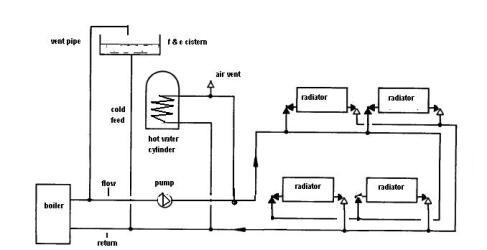 Typical two pipe reverse return pumped central heating layout
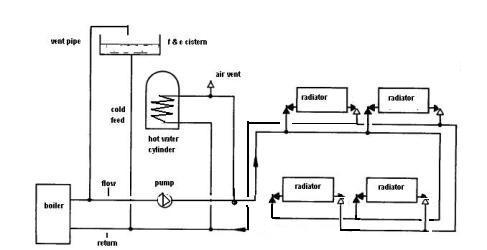 Typical two pipe central heating layout
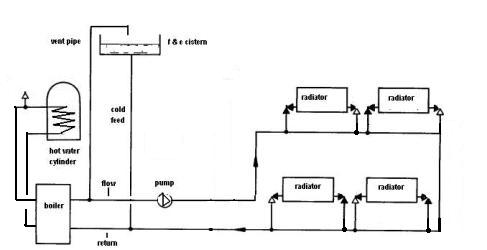 Typical single pipe pumped central heating layout and gravity hot water
See also:
Click here to visit online store.
Home Heat Loss Heat Gain Radiant Heat Central Heating Radiators UFH
Heat Pumps GSHP's WSHP's ASHP's Solar Heating PV Systems Boilers
Water Heaters Insulation Elec-Heaters
Terms of Use | Privacy | Contact Us



|

Visitors Say
Hi, My name is Shannon and I'm one of home-heating-systems-and-solutions.com readers. I'd like to thank you for the excellent information I've found on home-heating-systems-and-solutions.com, it's one of my favorite readings on the net. Warmest Regards Shannon United States
Thanks for the advice for removing an air lock from an indirect system. Had to change an inlet on my cistern. First time I have tried any home plumbing. After draining the cold tank system air locked when I refilled the tank. Garden hose and mains pressure up the tap sorted my problems. Would not have known what to do without the advice on the site. Many thanks Sean United Kingdom.
An excellent site. I have found it very usefull. I am currently in the design phase of a new house and have be pondering which heat system to use. From your site I have been able to choose the right system. Ross New Zealand
I enjoyed your site. Pat United States
We're so excited to announce our first Children Book
The Special and Talented Dog Show
To order click here
The second book published is called
Flying Things
This is aimed at a pre-school audience and is a rhyming story. You can buy by clicking here
To read more about our children's books, click here
