Boiler Short Cycling
Short Cycling
Boiler short cycling occurs when a boiler subject to its own internal thermostat 'fires up' - starts operating when the thermostat detects that the water in the boiler has cooled down.
For example:
When your heating system does not require the boiler to fire, the heated water in the boiler's heat exchanger will begin to loose heat to the air around the boiler's casing and through the flue. This loss of heat is not related to any loss of heat in your home.
Short cycling is simply the boiler firing up to re-heat the water in it's own heat exchanger when that water has cooled down. Because this water heats up quickly, the temperature that the thermostat is set to is also quickly achieved and when this happens the boiler is again shut down.
The boiler can continue to fire, heating the water in the heat exchanger and shutting down for a prolonged period of time without actually producing any heat for your home.
When the boiler is running and not producing heat for your heating system this 'short cycling' is:
- Wasting energy - increasing your fuel bill - and
- Damaging to the boiler's heat exchanger from constant localized boiling
An essential part of a modern efficient central heating system is the prevention of boiler short cycling.
Preventing Short Cycling
In a fully automatic central heating system the short cycling of the boiler can be prevented by using the room thermostat/programmer and hot water cylinder thermostat to switch on the electrical supply to the boiler. This wiring arrangement is called a 'boiler interlock', meaning that the boiler can only fire when there is a demand for space heating, and/or for hot water.
A boiler interlock will:
- Protect the life of the boiler
- Save you money - and
- Save energy
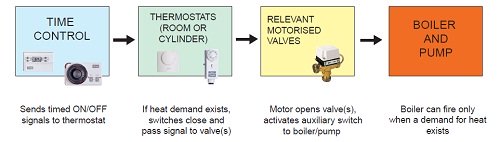 Typical heating interlock wiring control sequence
Click here to visit online store.
Top of Boiler Short Cycling page
Home Heat Loss Heat Gain Radiant Heat Central Heating Radiators UFH
Heat Pumps GSHP's WSHP's ASHP's Solar Heating PV Systems Boilers
Water Heaters Insulation Elec-Heaters
Terms of Use | Privacy | Contact Us



|

Visitors Say
Hi, My name is Shannon and I'm one of home-heating-systems-and-solutions.com readers. I'd like to thank you for the excellent information I've found on home-heating-systems-and-solutions.com, it's one of my favorite readings on the net. Warmest Regards Shannon United States
Thanks for the advice for removing an air lock from an indirect system. Had to change an inlet on my cistern. First time I have tried any home plumbing. After draining the cold tank system air locked when I refilled the tank. Garden hose and mains pressure up the tap sorted my problems. Would not have known what to do without the advice on the site. Many thanks Sean United Kingdom.
An excellent site. I have found it very usefull. I am currently in the design phase of a new house and have be pondering which heat system to use. From your site I have been able to choose the right system. Ross New Zealand
I enjoyed your site. Pat United States
We're so excited to announce our first Children Book
The Special and Talented Dog Show
To order click here
The second book published is called
Flying Things
This is aimed at a pre-school audience and is a rhyming story. You can buy by clicking here
To read more about our children's books, click here
