Rainwater Tanks
Traditionally rainwater tanks are associated with rural living - this however is changing in some urban areas as more people are becoming aware of the fact that rainwater is free. Installing these tanks (space permitting) can greatly reduce your household water bills.
Note: Although you can install a single rainwater tank the general practice today is to install a pair of tanks. One could be to act just as a back-up to the primary tank, or it could be mains fed from the town supply topping up the primary tank in the event of no rainfall. Also, most rainwater tanks today are fitted with a water pump, this gives improved water pressure at outlets and flexibility in tank location.
What's on this page:
Why You Should Use Rainwater Tanks
Well, simply because you can save quite large amounts of water that you can then use in your home and garden.
- By installing tanks you will safeguard your family in the event of public water restrictions
- The use of previously collected water in low rainfall periods
- Reduce the amount of water in the stormwater drains by collecting it in your tanks
- Using collected rainwater saves you money - it's free
What Health Issues Should I Be Aware Of?
There are some heath issues you should be aware of when thinking about installing a water collection tank or tanks, and they are:
- First ascertain whether your roof has any lead in it, or even in the paint, or any other toxic material like tar that may cause contamination
- Contamination from bird life droppings, organic matter that has collected on the roof (dead insects, birds etc), or air pollution from local industrial plants or rural chemical spaying
- Contamination by mosquito larvae in the water
These issues can be overcome so don't worry just be aware. The quality of the water has to be maintained and drinking water will have to meet the standards set by your health authority.
Rainwater Collection Tips
Here are a few tips to help you with rainwater collection.
- A plumber or tank manufacturer should install the tank to ensure efficient operation of the system combined with easy maintenance
- Confirm that the roof material is not toxic
- Use gutter/spouting mesh
- All opening cover by mosquito-proof mesh
- The downpipe should be fitted with a 'First Flush Diverter*'
- Additional sump box between the downpipe and tank can separate any sediment not previously diverted by the diverter pipe
- Overflow to be connected to a suitable drain or irrigation system
- The rainwater tank(s) should be aerated to prevent stagnation
- Clean every few years to remove any accumulated sediment
- If you are going to install a large tank then you may need to consult with a builder or engineer concerning structural support
*First Flush Diverter is a branch pipe connected to the tank supply pipe before the tank. The purpose of this pipe is to collect and divert away the first 20 - 25 litres of rainfall that may contain dirt and dust. This diverter pipe usually has a float that closes off the water to it when it is full. The pipe is emptied via a slow drip system.
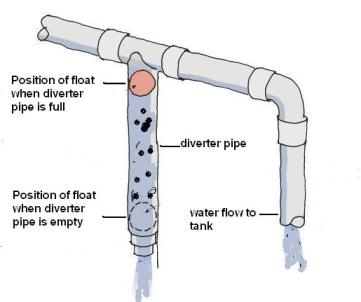 First flush diverter pipe
Click here to visit online store.
Home Heat Loss Heat Gain Radiant Heat Central Heating Radiators UFH
Heat Pumps GSHP's WSHP's ASHP's Solar Heating PV Systems Boilers
Water Heaters Insulation Elec-Heaters
Terms of Use | Privacy | Contact Us



|

Visitors Say
Hi, My name is Shannon and I'm one of home-heating-systems-and-solutions.com readers. I'd like to thank you for the excellent information I've found on home-heating-systems-and-solutions.com, it's one of my favorite readings on the net. Warmest Regards Shannon United States
Thanks for the advice for removing an air lock from an indirect system. Had to change an inlet on my cistern. First time I have tried any home plumbing. After draining the cold tank system air locked when I refilled the tank. Garden hose and mains pressure up the tap sorted my problems. Would not have known what to do without the advice on the site. Many thanks Sean United Kingdom.
An excellent site. I have found it very usefull. I am currently in the design phase of a new house and have be pondering which heat system to use. From your site I have been able to choose the right system. Ross New Zealand
I enjoyed your site. Pat United States
We're so excited to announce our first Children Book
The Special and Talented Dog Show
To order click here
The second book published is called
Flying Things
This is aimed at a pre-school audience and is a rhyming story. You can buy by clicking here
To read more about our children's books, click here
